

What a former press secretary wishes he’d known about journalists
News originally published by
EIN Presswire Blog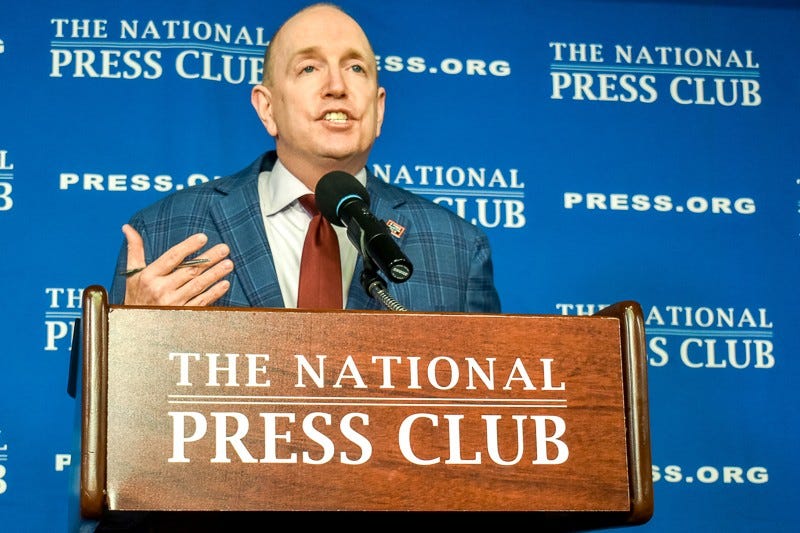
If Mark Schoeff Jr. could wave a magic wand and go back in time to when he was a press secretary, he would still send out press releases, but he’d also dedicate time to getting to know the people receiving them.
“If I had it to do over, I would have spent a lot more time having coffee with reporters so that when the phone started ringing, I had a firmer grasp of emerging issues and coverage,” Schoeff said in an exclusive interview with EIN Presswire.
Now, as president of the world’s leading professional organization for journalists, Schoeff has used his experience on both sides of the media industry to help guide initiatives and programs that serve National Press Club members.
The organization doesn’t just cater to journalists. It also welcomes people across the journalism and communications spectrum, such as public relations professionals, press secretaries, communications directors, and others.
Schoeff noted that communicators make up a portion of the NPC’s membership, and both journalists and communications professionals bring valuable perspectives that support the organization’s broader mission to foster ethical standards in the industry and act as an advocate for a free press.
“Knowing what is important to both journalists and communicators has helped me shape my agenda this year,” he said. “I want to make sure our club programs and initiatives serve not only journalists but also are valuable to our communicator members.”
When Schoeff isn’t spearheading the next NPC event, he’s on the ground covering financial news as a reporter for CQ Roll Call.
His time in the newsroom and experience in communications have shaped his perspective on what makes a good media pitch, why relationships matter and what PR professionals can do to become more valuable sources for reporters.
Meanwhile, the NPC is also working to bridge the gap between communicators and journalists through roundtable discussions designed to help professionals in both fields better understand each other’s roles.
“I have attended three of our Journalist-Communicator Roundtables this year,” Schoeff said. “Those dinners center on a discussion of emerging challenges in the communications field.”
In the interview, Schoeff touched on how AI should be used in newsrooms, reflected on his early career and shared his thoughts on who gets to call themselves a journalist today.
Editor’s note: This interview has been slightly edited for length, clarity and brevity.
Q: Tell us about your journey and career path - and what led you to become president of one of Washington, D.C.’s most iconic institutions.
A: My journey into journalism started when I realized in high school that I was too short and too slow to play basketball. Seeing no future on the hardcourt, I quit the sophomore team at Ft. Wayne (Ind.) Northrop High School.
That was a traumatic experience at the time. One day, when I was moping around the halls, Northrop’s journalism teacher said, “Mark, if you can’t play sports, why don’t you write about them.”
I joined the Northrop newspaper as a sports reporter and, over the years, worked my way up to editor-in-chief. Meanwhile, I became a stringer for the sports desk of Ft. Wayne’s then afternoon paper, The News-Sentinel.
When I saw my first News-Sentinel story - about a high school football game the previous night - in print, it was a thrill. I had started on the path toward becoming a journalist.
The journalism flame that started burning in high school became a fire in college. My formative experience at Purdue University was working for three years on the daily campus newspaper, The Exponent. I served as a staff writer, city editor, campus editor and senior writer.
I loved being part of The Exponent. We didn’t just inform our readers about what was happening on campus, we helped make it a better place for students, faculty, staff and the administration.
After college, I moved to New York City for almost a year. I worked at a human resources and corporate communication consulting firm. On the side, I was managing editor of the community paper on Roosevelt Island.
In April 1992, I moved to Washington, D.C., where I joined the staff of then-Sen. Richard Lugar of Indiana. I served as Sen. Lugar’s press secretary from 1995-97. I then became director of external relations at a think tank, the Center for Strategic and International Studies.
While working at CSIS, I freelanced for a political newsletter, Howey Politics Indiana. In 2005, I became a full-time reporter with Workforce Management, a trade magazine published by Crain Communications. I covered employment and labor law.
In 2010, I moved to another Crain Publication, InvestmentNews, where I worked until 2024. In June 2024, I joined CQ Roll Call, where I am now the financial services reporter.
I joined the National Press Club in 2005 and was inspired by its community of journalists and communicators. Every year since then, I have been a leader or co-leader of a Club team. For instance, I served for 14 years as co-leader and co-editor-in-chief of the Club’s (almost) daily electronic newsletter, The Wire.
I unsuccessfully ran for a Club board seat in 2018. I decided to try again in 2019 and won. I served on the board for several years, becoming chairman in 2023. In 2024 and 2025, I served in Club officer positions.
I was elected National Press Club president in November 2025 and have been serving in that role this year. My term will end in January 2027.
Q: People often say journalism is in crisis, especially with the rise of artificial intelligence. What are your thoughts on that?
A: Artificial intelligence presents both challenges and opportunities for journalism. The challenge is striking the right balance with AI when it comes to AI’s use of news content and newsroom’s use of AI.
So far, AI has educated itself in large part on the stories that journalists have produced. We must find a way to ensure that AI doesn’t simply steal that content. We have to protect journalism’s intellectual property that is making AI more intelligent.
In newsrooms, we also must find a balance in using AI to strengthen journalistic output but not to replace it. My editor-in-chief at CQ Roll Call gave us a good formula. He said we should use AI to augment our reporting. But never use AI to write a story. The reporter must begin with a blank screen and fill it with his or her words.
Q: How does the National Press Club cater to PR and communications professionals, and what do they gain from being members?
A: The National Press Club has two main categories of membership. One is a Journalist member, like me, who is an active reporter. The other is a Communicator member. Communicators tend to be press secretaries, directors of communication, public affairs professionals and sources for reporters.
The professional diversity of the Club is one of our strengths. Our membership spans the entire journalism-communications ecosystem. We are a community where journalists and communicators interact and come to better understand “the other side” of our daily professional lives.
Communicators are valued members of the Club community. Our Communicator members help to make the Club unique among journalism organizations.
Q: Has your extensive experience as a reporter covering different beats influenced the way you lead the National Press Club?
A: As both a freelance and full-time reporter, I have covered politics, employment and labor law, insurance and financial services. That experience has given me a feel for several different beats. As I mentioned earlier, I also spent a significant part of my career as a communications professional.
My experience across the journalism-communications ecosystem has given me a good feel for the demands of each side and the ways to succeed in each area. I have kept that perspective in mind as Club president.
The Club, of course, prioritizes journalism. We are the world’s leading professional organization for journalists. Our Club officers must be Journalist members.
Journalists and Communicators strongly support the Club’s primary mission, which is advancing press freedom. I hear often from Journalists and Communicators about how important it is for the Club to remain at the forefront of the effort to ensure that journalists are able to do their jobs without restrictions or threats.
Q: You served as press secretary for Sen. Richard Lugar of Indiana. Knowing what you know now, what did “PR Mark” do that “journalist Mark” would roll his eyes at?
A: Journalist Mark rolls his eyes at the importance PR Mark placed on churning out press releases. Journalist Mark understands the importance of developing relationships with sources at a much deeper level than PR Mark did.
When I was Lugar’s press secretary, I was always conscientious about responding to reporters in a timely way and providing the insight and information from Lugar - to the greatest extent I could - that would help them with their reporting.
But what I didn’t do enough as Lugar’s press secretary was get to know reporters individually and understand the trajectory of their coverage. That would have made a better resource for them.
Q: You’ve spent time both as a reporter and on the communications side. What did seeing journalism from the other side teach you that you wish more people understood?
A: What I have learned as a reporter - and that I wish more PR professionals understood - is that news is the coin of the realm. Each day, journalists are voraciously seeking news. To the extent that communications professionals can help them find and report news, the better it is for both sides.
It’s fine to pitch the latest activity or development involving your boss, company or organization. But if it’s not news, it’s likely going to be ignored by reporters. You have to find a way to connect your principal to the news, or offer real news from your principal, to get traction on your message.
Q: The line between journalist, newsletter writer, independent creator and communicator is getting harder to see. Who gets to call themselves a journalist now, and does that distinction still matter?
A: This is a question that the journalism profession - and the National Press Club - will wrestle with for years. I’m not sure that we’ll ever have a definition of journalist that is set in stone. It will have to evolve with each advance in the way humans communicate with each other.
But it is important to distinguish between who is and who is not a journalist. Some fundamentals are likely to always apply.
For instance, to be a journalist, you have to work for a news organization or be an independent reporter funded by subscriptions, advertising or a nonprofit organization. Your primary mission is to gather news with integrity. Your focus is on finding the truth and conveying it to your readers, viewers and listeners.
Creators and communicators can engage in activities that look like journalism, such as interviewing sources. But they may not produce journalism in their final product because that product is meant to promote the brand or organization that is paying them.
Even the criteria I outlined above is sometimes subject to interpretation. That’s what makes it so difficult to sort out who is a reporter.
Legal Disclaimer:
EIN Presswire provides this news content "as is" without warranty of any kind. We do not accept any responsibility or liability for the accuracy, content, images, videos, licenses, completeness, legality, or reliability of the information contained in this article. If you have any complaints or copyright issues related to this article, kindly contact the author above.
